Key Takeaways
- Serving toward the glass forces predictable backhand body returns and allows the server’s partner to remain active in the point.
- Hugo Cases stressed aggressive intent on the follow-up touch: “When we are serving, we have to try to win the point as soon as possible.”
- Low returns below the tape require short angles or drop shots toward the fence rather than attempting long volleys back into play.
Maximizing court advantage from the opening shot
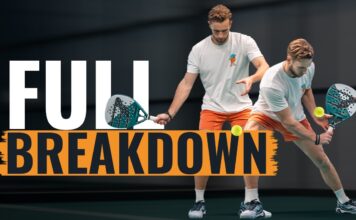
While padel players frequently spend their training sessions polishing overheads and smashes, the outcome of most rallies is established much earlier. On court at Rocket Padel Bristol, former World No. 31, four-time champion of Madrid, and World Padel Tour commentator Hugo Cases joined Gonzalo to break down the tactical dynamics governing the first two touches of a point.
When serving from the left side, directing the initial ball toward the glass offers immediate structural advantages for the serving pair. Cases emphasized how that choice dictates the opponent’s return and activates both net players effectively. “When you serve in that side and you have to come to your side, it’s better if you serve to the glass,” Cases explained. “When you serve to the glass, if I have to return with my backhand, probably I will return from that side to your body. So, you cover all these things and your partner is going to play.”
Targeting the side wall also tends to produce a friendlier first volley for the server advancing into position. As Cases pointed out, “it’s good to serve to the glass because your partner is going to play and also probably the next volley you will do is your forehand.” From there, the server can punish the returner’s positioning by going into the open court or exploiting the opposite corner.
Weighing target options between the wall and the center line
In contrast, serving directly down the center line to the ‘T’ can concede attacking angles to the returning team. If the returner anticipates the trajectory, the server’s partner can be completely bypassed in the rally. Cases noted the tactical contrast: “If you serve to me to the T, it’s true that I am outside of my side, but I can play to your angle or I can do lob. But, this player is not going to play and it’s your partner. So, you have to use your partner.”
While variation remains essential against competitive opponents, repeating an ineffective placement down the center can quickly backfire. “You can have variety. You can serve to the glass, you can serve to my body, or you can serve here, of course. But, if you do that the first time, and I do that maybe it’s better to serve to my body or to keep playing to the glass,” Cases observed during the drill.
Executing aggressive first volleys under pressure
The transition from the baseline to the net requires reading the opponent’s defensive posture in real time. Rather than simply blocking the ball back into court, Cases stressed that the server must recognize when to attack with touch, drawing a clear parallel to traditional racket sports. “Play always far from the rival,” Cases said. “Like in tennis. In tennis we know that we have to play far. But in paddle we don’t think in that. And it’s the same concept.”
When the return arrives dipping beneath the net band, trying to force depth can cause routine errors. Cases highlighted the technical adjustment required for low incoming balls: “I think when the ball is lower than the net is always short. Always short. Drop shot to the fence but never is long again.”
Ultimately, holding serve requires treating the initial two shots as a platform to finish rallies quickly rather than just beginning a neutral exchange. “When we are serving, we have to try to win the point as soon as possible,” Cases summarized. “And the other option or the other thing is that that volley I have to try to win the point because if we have a good serve, we have the rival moved and we only put the volley in, we are giving them the ball again and we have to use the situation that we are serving and in theory we are in the domain of the point.”