Key Takeaways
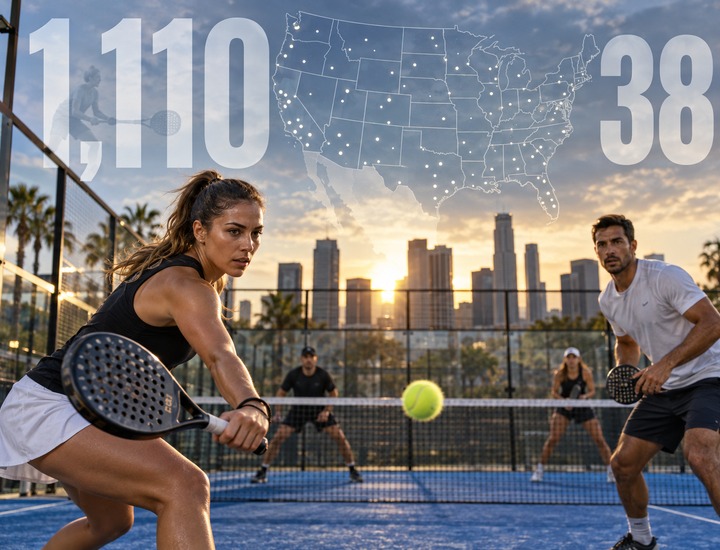
- A new report by Misitrano Consulting shows U.S. padel grew 61.6% year-on-year to 1,110 courts across 38 states as of Q2 2026.
- Facilities increased 65% to 296 venues nationwide, with active players estimated at 460,000.
- Founder Patricio Misitrano observed that “the window is still open, the challenges are real, and the operators who show up with real numbers instead of good intentions are the ones who’ll still be standing in five years.”
New report by Misitrano Consulting maps rapid national growth
Padel is cementing its position across the United States as court infrastructure and player participation surge nationwide. According to The US Padel Report 2026, the second annual data-led national study published on 24 September 2026 by Misitrano Consulting, the sport has extended its presence to 38 states with 1,110 active courts as of Q2 2026.
The figures mark a 61.6% rise compared to the 688 courts operating across 31 states recorded 1 year earlier. The expansion of venues has outpaced court growth, climbing 65% from 180 to 296 active facilities, while the domestic player community has reached an estimated 460,000 active participants.
Infrastructure trends and steady court rates
Synthesizing proprietary research, verified projections, data scraping, and direct interviews with venue operators, the study reveals significant operational and geographic shifts across the country. Seven states added their first padel facilities during the past year. At the same time, indoor facilities represent 42% of the national court count, up from 39.1% in 2025, driven by weather demands and real estate dynamics outside the traditional Sun Belt.
Co-location alongside pickleball has also expanded, with 39.4% of padel facilities offering both racquet sports, rising from 36.7% and moving from 66 to 117 crossover locations in 12 months. Despite the heavy injection of new court capacity, national pricing remained stable at a median hourly rate of $100 for indoor peak, $80 for indoor off-peak, $80 for outdoor peak, and $60 for outdoor off-peak. The report emphasized that growth has been fueled by new supply rather than rate discounting.
Discipline required as geography broadens
Historically dominant markets are also seeing their relative footprint balance out across the nation. The joint share of total U.S. facilities located in Florida, Texas, and California dropped from 65% to just over 50%, even as all 3 states continued to add venues in absolute terms.
Addressing the state of the market, Misitrano Consulting founder Patricio Misitrano emphasized the importance of operational rigor amid rapid scaling.
“This year’s data confirms what last year’s data suggested,” Misitrano stated. “The window is still open, the challenges are real, and the operators who show up with real numbers instead of good intentions are the ones who’ll still be standing in five years.”
The report concluded that while substantial opportunities exist in real estate club developments, indoor conversions, and multi-site rollups, operators face clear risks if capital expansion outpaces disciplined management.