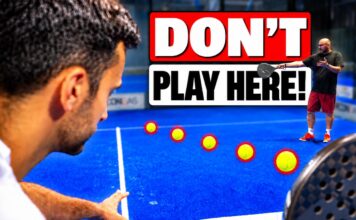

Many amateur players rely heavily on slice, believing it adds sophistication to their game. Yet professionals prefer flat shots because they reduce variables and build consistency. As coach Danny Oyo explains, “With flat shots, what we are doing is build simple mechanics and we are reducing variables.” The philosophy is clear: padel rewards regularity under pressure more than occasional brilliance.
Consistency from the back of the court
Flat hitting provides a stable base from deep positions. It allows players to execute lobs, chiquitas, and standard groundstrokes without risking floating balls that give opponents time to counter. When rallies are fast and opponents hit hard, slicing becomes unreliable. Flat shots ensure pace and control, forcing rivals to react quicker.
Efficiency at the net
At the net, flat volleys and overheads are safer and more energy‑efficient. A sliced overhead demands more effort and often slows the ball, giving opponents time to reposition. A flatter overhead, by contrast, travels faster and conserves energy. As Oyo notes, less effort combined with more speed is a double benefit: saving stamina while reducing the opponent’s decision‑making time.
Balance between slice and flat
Professional players rarely eliminate slice entirely. Instead, they use it sparingly, as seasoning rather than the main ingredient. A Spanish coach once told Oyo, “The slice is like the salt on the food. If you put too much, the food is not good.” Pros such as Agustín Tapia and Paula Josemaría demonstrate this balance, relying primarily on flat shots while introducing slice only when conditions allow.
Long‑term performance
Flat hitting is not just about winning points today; it is about sustaining performance across a season. Slice demands constant precision and physical sharpness, while flat shots allow players to compete even when tired, injured, or under pressure. The best padel players are those who can repeat simple, effective actions consistently over time.
Training cues for flatter shots
Players can begin adjusting by listening to the sound of their strokes: flatter shots produce a louder, crisper impact. Correct grip also plays a crucial role, enabling forehands and backhands to stay compact and direct. By focusing on these fundamentals, players can gradually shift toward a flatter style that mirrors the professional approach.